
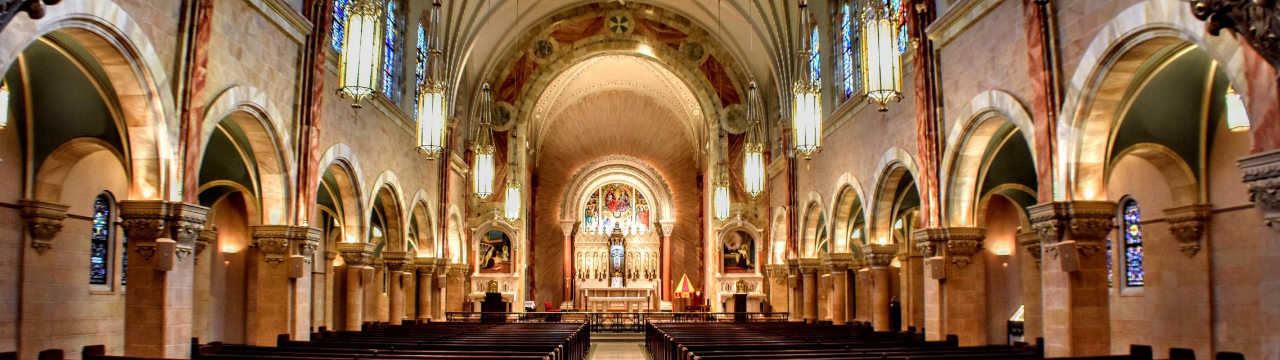
The word basilica is derived from a Greek term meaning “royal court”—from which the king exercised his reign. In the Catholic world, a basilica is a church building that has been recognized and accorded special privileges by the pope.
There are two types of basilicas. The world’s four major (or papal) basilicas are St. John Lateran, St. Peter’s, St. Paul Outside-the-Walls, and St. Mary Major—all of which are in Rome. Minor (or lesser) basilicas are significant churches in Rome and elsewhere in the world that meet certain criteria and are thus given special ecclesiastical privileges. Minor basilicas are traditionally named because of their antiquity, dignity, historical value, architectural and artistic worth, or significance as centers of worship. A basilica must “stand out as a center of active and pastoral liturgy” according to the 1989 Vatican document, Domus Ecclesiae.
Designation as a basilica indicates a special bond of communion with the pope, and therefore, the parish must celebrate “with particular care” the feast of the Chair of Peter on February 22, the solemnity of the Apostles Peter and Paul on June 29, and the anniversary of the pope’s election or his inauguration into pastoral ministry.
1,778 churches worldwide have been honored as basilicas. As of 2018, 385 basilicas had been designated in the Americas, including eighty-five in the United States.
Three physical signs indicate that a church is a basilica. The first is the presence of the ombrellino—a silk canopy resembling an umbrella, designed with stripes of yellow and red, the traditional papal colors—symbolizing the church’s special relationship to the person of the pope. The second sign is the tintinnabulum, or small bell, mounted on a pole and carried in procession with the ombrellino, at the head of the clergy on special occasions. It is traditionally rung if and when the pope comes to visit the church. The third sign of a basilica is the very public display of the distinctly papal symbol of “crossed keys,” the iconic symbol of St. Peter, on banners, on furnishings, and on the seal of the basilica.