Contact

[email protected]
+ 001 0231 123 32

Info

All demo content is for sample purposes only, intended to represent a live site. Please use the RocketLauncher to install an equivalent of the demo, all images will be replaced with sample images.

Click on a question below to reveal the answer.

  • What hours is Holy Hill open to the public?

    Building hours are 6:00 am to 5:00 pm. The Holy Hill grounds close at 7:00 pm.


  • How can I get an item blessed?

    Carmelite Friars are available to bless items at the following times/locations: 

    At 11:00 a.m. Daily Mass - Monday- Friday
    A blessing will follow each 11:00 a.m. daily Mass. Pilgrims are invited to bring religious items along for the blessing.

    Main Entrance Desk
    Friars are available to bless items at the desk outside the Gift Store during the following times:
    Sundays from 9:00 a.m. - 3:00 p.m.

    Monastery Office
    Friars are available to bless items at the Monastery office during the following times:
    Monday  - Friday -  1:00 - 3:30 p.m.


  • When is the scenic tower open?

    The Scenic Tower is open May 1 through October 31, Monday - Saturday from 9:00 AM - 4:30 PM and Sunday from 1:30-4:30 PM, weather permitting.

    The tower closes for inclement weather such as rain, high winds and lightning, as well as during some services.

    The Scenic Tower is closed November 1 - April 30. 


  • Do you offer retreats at Holy Hill?

    We welcome day and overnight retreats at Holy Hill.

    We offer simple, overnight accommodations to anyone seeking an opportunity to encounter the Sacred in a place apart from the busy world at our Guesthouse.

    Our retreat facilities are housed in two buildings, the “New Guest House” and the “Old Monastery Inn.” Holy Hill Guest House, as a center for spiritual retreats, maintains a strict no drugs, no alcohol, no smoking policy. No alcohol should be brought into the retreat house. Please Note: the New Guest House and Old Monastery Inn overnight facilities are older, and not handicapped accessible. Access for anyone with a disability can be quite a challenge, as there is a full flight of stairs to the New Guest House rooms, and the four levels in the Old Monastery Inn are connected only by stairs.


    For more information or to make reservations, please call 262-628-5286 or contact us at This email address is being protected from spambots. You need JavaScript enabled to view it..

    Download a Guesthouse/Retreat Center Brochure  here .

  • Can we get married at Holy Hill?

    We understand the interest in celebrating a wedding in the Shrine Church amid the beautiful surroundings which has come to be known as Holy Hill.  However, the Catholic understanding of the sacrament of marriage speaks of a covenant between a man and woman, and this celebration is most suited to be performed within the local community at the parish as a communal event.  Since Holy Hill is not a local parish, weddings are generally not permitted at the Basilica without a specific and standing communal relationship with Holy Hill and the advanced permission of the Holy Hill Rector.  If you are pondering a future marriage, know that our prayers are with you as you make your preparations to celebrate your wedding day as well as joyfully live out each day of your marriage grounded in the Lord Jesus.

  • Can we have our wedding photo session at Holy Hill?

    We find the disruptions that wedding party photography sessions cause detract from the spiritual experience of our visitors and guests and from our primary mission and purpose. Therefore, we do not grant permission for wedding photo sessions on our grounds.


  • How can I make a donation to Holy Hill?

    Your generous donations help us to preserve the sacred spaces of Holy Hill. Please visit our development page to learn more about supporting Holy Hill or make a donation here.

  • What is a Basilica?

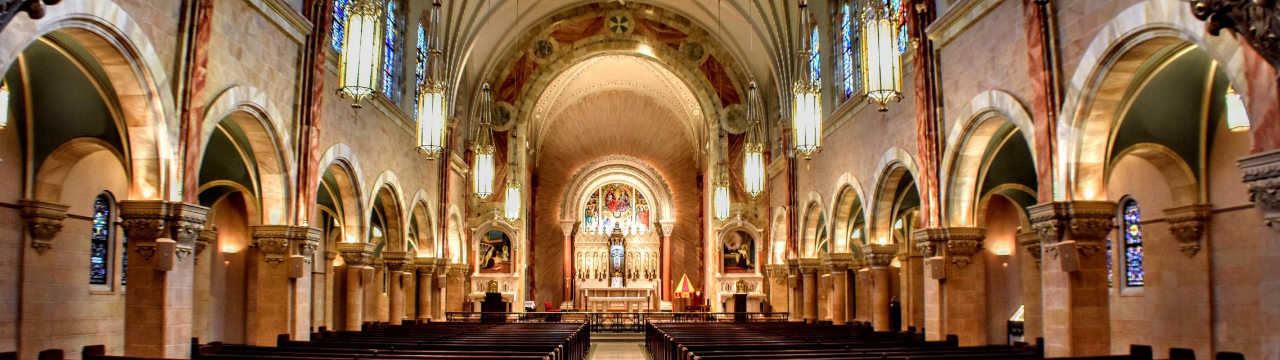
    The word basilica is derived from a Greek term meaning “royal court”—from which the king exercised his reign. In the Catholic world, a basilica is a church building that has been recognized and accorded special privileges by the pope.

    There are two types of basilicas. The world’s four major (or papal) basilicas are St. John Lateran, St. Peter’s, St. Paul Outside-the-Walls, and St. Mary Major—all of which are in Rome. Minor (or lesser) basilicas are significant churches in Rome and elsewhere in the world that meet certain criteria and are thus given special ecclesiastical privileges. Minor basilicas are traditionally named because of their antiquity, dignity, historical value, architectural and artistic worth, or significance as centers of worship. A basilica must “stand out as a center of active and pastoral liturgy” according to the 1989 Vatican document, Domus Ecclesiae.

    Designation as a basilica indicates a special bond of communion with the pope, and therefore, the parish must celebrate “with particular care” the feast of the Chair of Peter on February 22, the solemnity of the Apostles Peter and Paul on June 29, and the anniversary of the pope’s election or his inauguration into pastoral ministry.

    1,778 churches worldwide have been honored as basilicas. As of 2018, 385 basilicas had been designated in the Americas, including eighty-five in the United States.

    Three physical signs indicate that a church is a basilica. The first is the presence of the ombrellino—a silk canopy resembling an umbrella, designed with stripes of yellow and red, the traditional papal colors—symbolizing the church’s special relationship to the person of the pope. The second sign is the tintinnabulum, or small bell, mounted on a pole and carried in procession with the ombrellino, at the head of the clergy on special occasions. It is traditionally rung if and when the pope comes to visit the church. The third sign of a basilica is the very public display of the distinctly papal symbol of “crossed keys,” the iconic symbol of St. Peter, on banners, on furnishings, and on the seal of the basilica.

  • Can I scatter the ashes of a loved one or a pet at Holy Hill?

    As the Catechism explains, "The bodies of the dead must be treated with respect and charity, in faith and hope of the Resurrection. The burial of the dead is a corporal work of mercy; it honors the children of God, who are temples of the Holy Spirit." (CCC 2300)

    In its instruction entitled "Ad resurgendum cvm Christo", the Holy See clarified:
       "...When, for legitimate motives, cremation of the body has been chosen, the ashes of the faithful must be laid to rest in a sacred place, that is, in a cemetery or [...] an area which has been set aside for this purpose, and so dedicated by the competent ecclesial authority."

       "...The reservation of the ashes of the departed in a [cemetery or columbarium] ensures that they are not excluded from the prayers and remembrance of their family or the Christian community. It prevents the faithful departed from being forgotten, or their remains from being shown a lack of respect, which eventuality is possible, most especially once the immediately subsequent generation has, too, passed away. Also, it prevents any unfitting or superstitious practices."

       "...It is not permitted to scatter the ashes of the faithful departed in the air, on land, at sea or in some other way, nor may they be preserved in mementos, pieces of jewelry or other objects. These courses of action cannot be legitimized by an appeal to the sanitary, social, or economic motives that may have occasioned the choice of cremation."

    In keeping with this universal teaching of the Catholic Church, the scattering of cremated human remains at Holy Hill is strictly prohibited.

    If you possess cremated human remains and would like them to be reverently reposed, please contact your local parish.

    The cremated remains of pets cannot always be readily distinguished from human remains, and so, to avoid scandal and confusion (in addition to sanitary and practical concerns), the scattering of pets' remains at Holy Hill is likewise strictly prohibited.

  • «Español»: ¿Está permitido esparcir las cenizas de un ser querido o de una mascota en Holy Hill?

    Como explica el Catecismo, "Los cuerpos de los difuntos deben ser tratados con respeto y caridad en la fe y la esperanza de la resurrección. Enterrar a los muertos es una obra de misericordia corporal, que honra a los hijos de Dios, templos del Espíritu Santo." (CEC 2300)

    En su instrucción titulada «Ad resurgendum cvm Christo», la Santa Sede aclaró la cuestión:
       "...Si por razones legítimas se opta por la cremación del cadáver, las cenizas del difunto, por regla general, deben mantenerse en un lugar sagrado, es decir, en el cementerio o [...] en una iglesia o en un área especialmente dedicada a tal fin por la autoridad eclesiástica competente."

       "...La conservación de las cenizas en un [cementerio o una palomera] puede ayudar a reducir el riesgo de sustraer a los difuntos de la oración y el recuerdo de los familiares y de la comunidad cristiana. Así, además, se evita la posibilidad de olvido, falta de respeto y malos tratos, que pueden sobrevenir sobre todo una vez pasada la primera generación, así como prácticas inconvenientes o supersticiosas."

       "...No sea permitida la dispersión de las cenizas en el aire, en la tierra o en el agua o en cualquier otra forma, o la conversión de las cenizas en recuerdos conmemorativos, en piezas de joyería o en otros artículos, teniendo en cuenta que para estas formas de proceder no se pueden invocar razones higiénicas, sociales o económicas que pueden motivar la opción de la cremación."

    En consonancia con esta enseñanza universal de la Iglesia Católica, está estrictamente prohibido esparcir restos humanos cremados en Holy Hill.

    Si tiene cenizas y desea darles sepultura reverente, comuníquese con su parroquia local.

    Como no siempre es posible distinguir fácilmente los restos incinerados de las mascotas de los humanos, y para evitar escándalos y confusiones (además de por motivos sanitarios y prácticos), también está estrictamente prohibido esparcir los restos de mascotas en Holy Hill.

  • 1